
Legendary Soviet Aviation Clock AChS-1 (ru: АЧС-1)
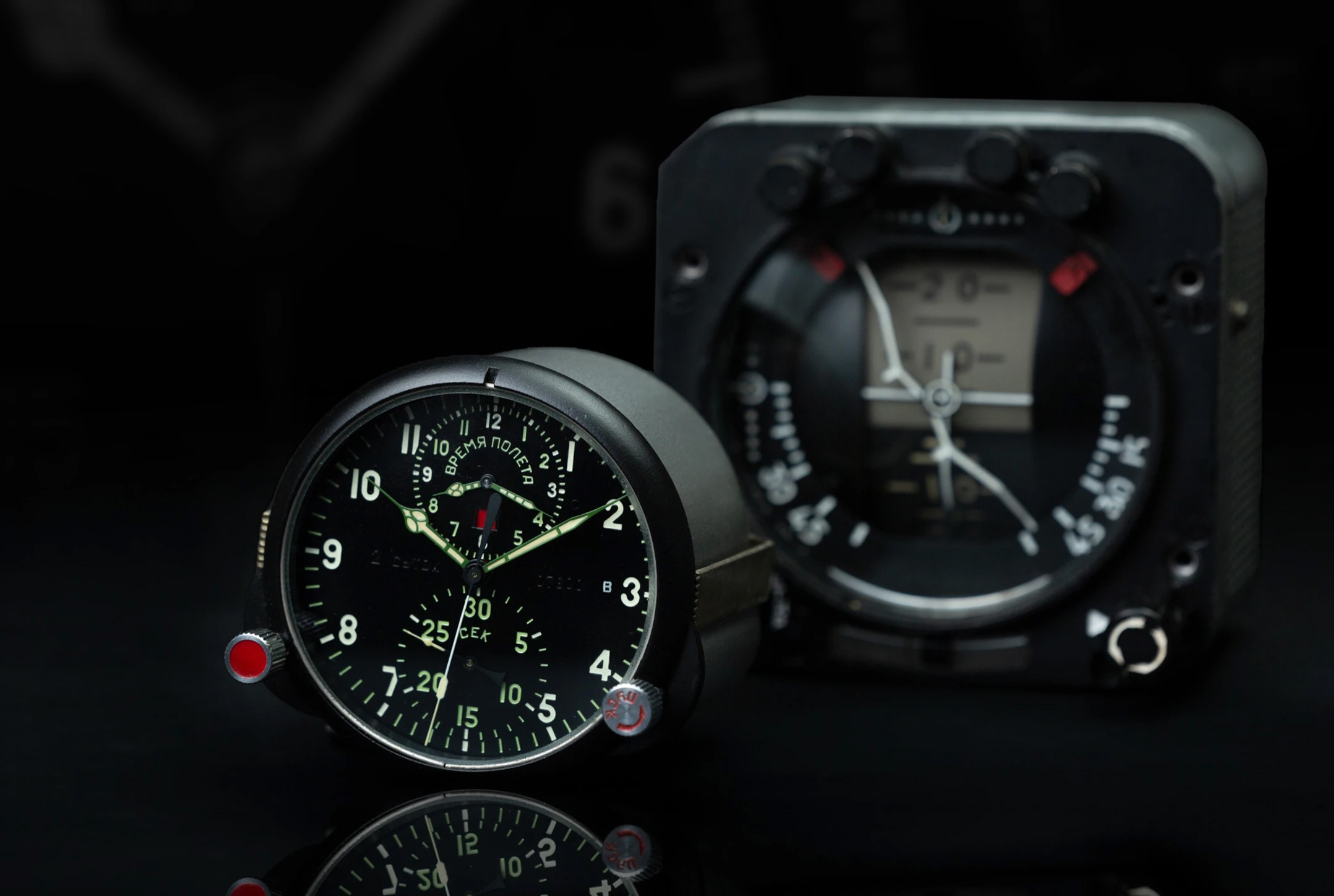
AChS-1 Aviation Clock (Aviation, Clocks, Stopwatch): Not just precise mechanical instruments in aircraft’s onboard equipment, but also sought-after souvenirs among aviators. What comes to mind when reminiscing about retired airplanes? Naturally, AChS-1. They vanish like lightning after the final flight, just as swiftly as the engines cool down.
For decades, these clocks have been installed on both civilian and military aircraft, thanks to their reliability and resilience to stresses and temperature fluctuations. AChS-1 boast ergonomic design and enduring performance both in times of peace and in combat conditions.
History:
The first onboard aviation clocks (AVR-M with an 8-day manual winding) were introduced in 1948, merely a year after the launch of the Chelyabinsk Watch Plant. The original model was designed and produced by the 1st Moscow Watch Factory. These watches were used on the initial Soviet military aircraft: close-range bombers Su-2, reconnaissance and assault aircraft, long-range bombers Il-4, as well as fighters like MiG-1, MiG-3, Yak-1, and others.
In the 1950s, production of a new model began — AChS-1. The prototype was inspired by clocks from the Swiss company JAEGER LECOULTRE CHRONOFLITE. Manufacturing started at the “First Moscow Watch Factory” and later transitioned to the Chelyabinsk Watch Plant “Molniya”. AChS-1 became a flagship product for the plant, first appearing on the MiG-15 — a legendary jet fighter — and then finding success across generations of Soviet combat aircraft: MiG, Su, TU, An, Yak.
AChS-1 aviation clocks remain highly sought-after in the market, symbolizing the Soviet Air Force. Their dependability, resilience, and convenience have made them indispensable companions in the air and on the ground. The term “AChS-1” has become synonymous with aviation clocks due to their unparalleled features and rich history.
 659
659 Buy in one click